|
ITINERARY:
Day 1 -
ATHENS - CORINTH - PELOPONESE PENINSULA Meet
at Hotel Philippos in central Athens at 2.00PM
and board our private bus to transfer to Tolo on the the Peloponese
Peninsula.
On our way to Tolo we pause at the Corinth Canal. In
ancient times the city-state of Corinth was a busy sea-port
due to its location on the narrow isthmus joining the
Adriatic and the Aegean.
By late
afternoon we reach our hotel in the small town
of Tolo. Like most places in Greece,
legends abound here. Tolo was first written about by Homer who
mentioned the Acropolis of Asine that
still sits on a small hill near our hotel. It is claimed
that the warriors from the Argos
region set sail for the Trojan wars from Tolo. Today,
it is a quiet beachfront town with the Aegean sea lapping on sandy
shores. The view from the hotel balconies is stunning.
Day 2 - COUNTRYSIDE
WALKING
Choose either a relaxed
"Philosophers" walk or a more energetic "Olympian" hike.
Our coach takes
us a short distance to the lovely village of Karya. This traditional village is nestled
700 metres above sea level
in the foothills of the Lirkio range and is surrounded by trees said to date from
the time of Menelaus (Helen of Troy's husband) in the 5th
century BC.
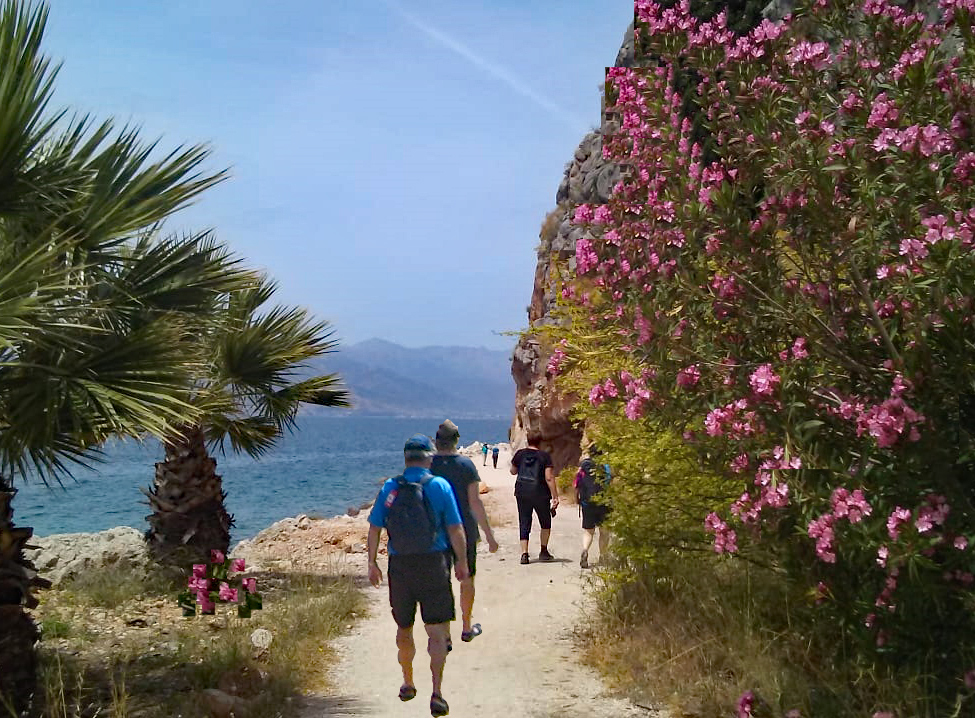
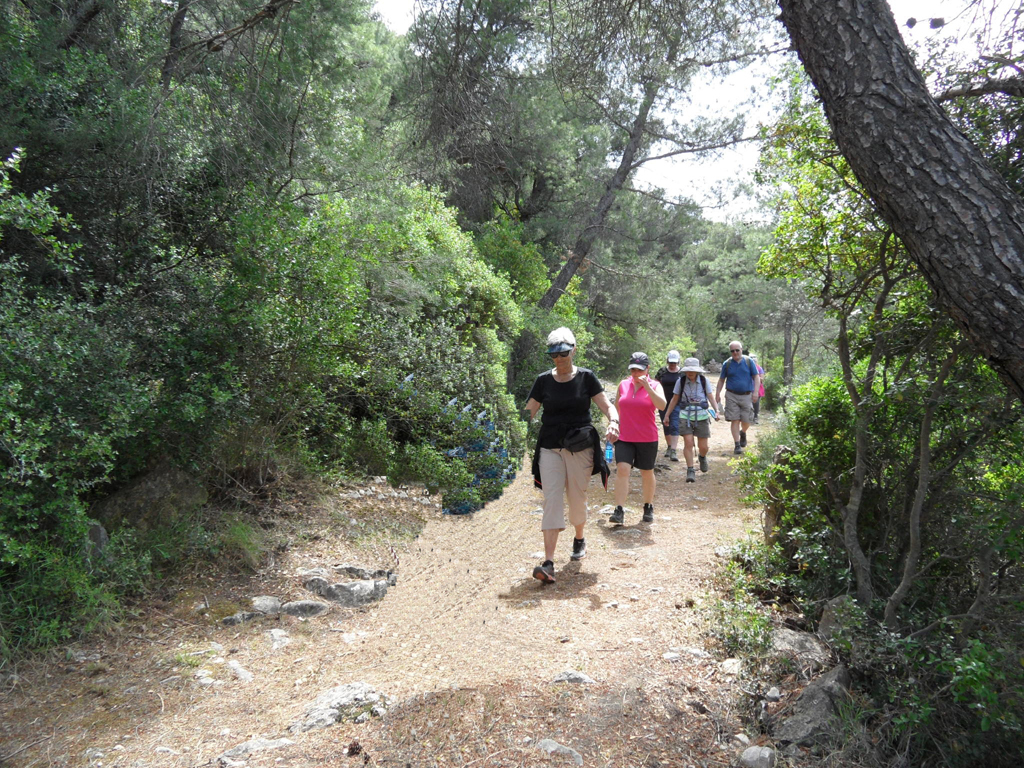
From our village base we have a
choice of two hikes on paths scented by wild thyme and
oregano. The Philosophers' walk (about 4 km) is quite
flat going through Arcadian scenery where our only
companions are goats and shepherds. One almost expects
Pan (the Greek god of shepherds) to appear.
The Olympian walk (about 9 km with 300 metres ascent) takes walkers
through a forest up the
mountain overlooking the village. Along the way, we see Byzantine water mills used in medieval
times for grinding cereal crops.
Both groups meet for
a picnic lunch in the shade of plane trees surrounding the
courtyard of a country church. After
lunch, there may be time for another walk before a visit to a winery
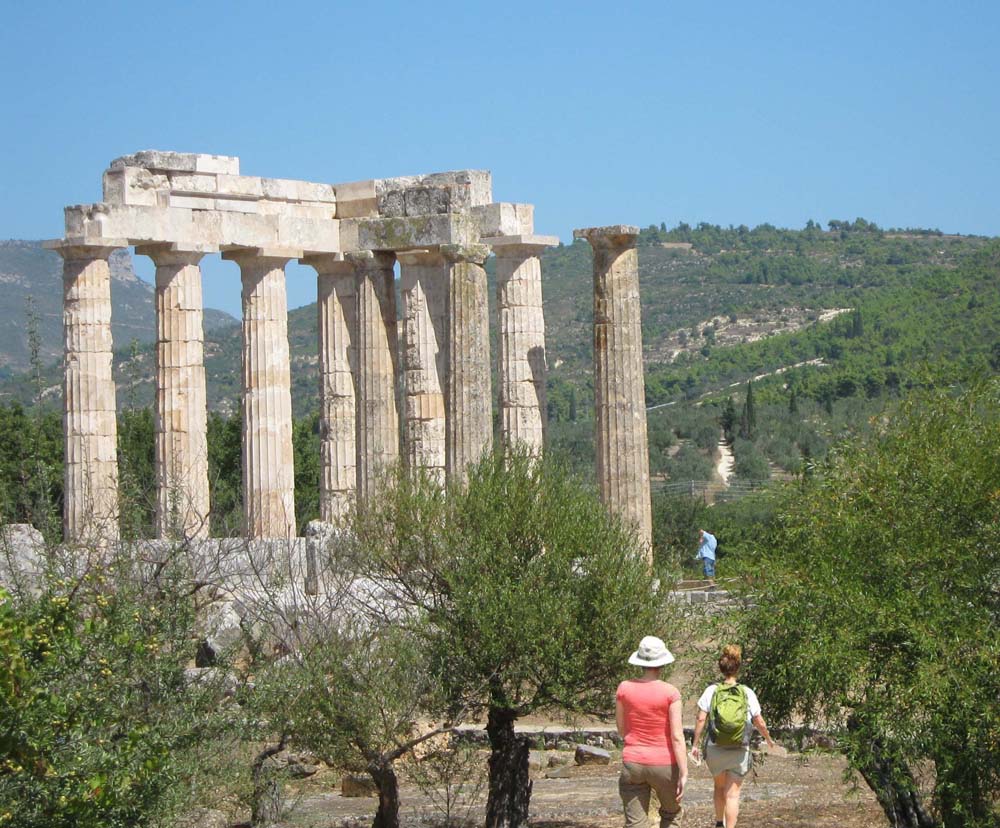
in Nemea where the mythic companion is Hercules (the
legendary hero who performed 12 labours including slaying
the Nemean Lion). Back in Tolo, there is time for a
swim or a stroll on the beach.
Day 3
EPIDAURUS - THE HEALING PATH - This morning
both the Philosopher and Olympian paths lead through ancient olive orchards.
The Olympian walk is 7 km long on a path above the
archaeological site overlooking the theatre and olive
groves.
The Philosopher walk is 2 km in olive groves and then 2 km
along the Healing Path which is a portion of the ancient
pilgrim route. Ruts in the stone are believed to have been
from ancient chariots. Today our mythical companion for the
day is Asklepios (the god of healing).
After our morning walk we
transfer to the small seaside village of Palaia Epidaurus which is located on a pretty, natural cove.
This harbour has over 3500 years of history. In ancient
times it was an important port and gateway used by ships bringing
visitors who were coming to the famous healing centre
of Asklepius located a few kilometres inland. Today one can see ruins of
an ancient temple dedicated to Artemis (goddess of the hunt), a
small Roman theatre and a "sunken city" that lies underwater a few
hundred feet from the beach.
There are seaside cafes in the village for lunch or you could take a
picnic. Here there is an optional 5 km walk on a quiet road.
Later we return to Tolo in time for a swim in the
hotel's lovely pool or a stroll on the beach or in the town
where you will find ice-cream shops and bakeries. Have
a drink at the outdoor pool bar or on your balcony as you
enjoy the panoramic view over the sparkling Aegean.
Day 4 - ONE DAY CRUISE a small cruise ship from Tolo goes to the small islands of Spetses and Hydra.
Of course our mythical companion for the day is Poseidon,
god of the sea, and often dolphins accompany us frolicking
in the ship's wake. Both islands can be explored on foot
(cars are not permitted on Hydra). The
history here is fascinating although it is not ancient. Merchant seafaring was
the main source of livelihood in these rocky islands and it
brought prosperity - especially during the Napoleonic wars
when Greek shipping magnates made fortunes working with both belligerent
sides. In 1821 Spetses was the first Greek island to raise
the flag of Revolution. The wealthy sea captains who had
been hoarding gold quickly dug up their buried
treasure, funded the revolution and liberated the territory
from the Ottomans. One can read about the story of Bouboulina, a
swashbuckling female who used
her own wealth to fund a fleet during the War of
Independence. She survived the war but in the end was shot
and killed in a family feud. Another Greek tragedy. Today, Spetses’ quiet beauty attracts Greek billionaires plus
international novelists and pop stars seeking a retreat.
Huge state-of-the-art yachts are moored at the marina
alongside quaint fishing boats. There are pleasant coastal
walks on both islands as well as cafes and shops. The cruise returns to Tolo
harbour in early evening.
Day 5
- EPIDAURUS This morning we have a half day
of walking including a tour of the amazing site of
Epidaurus (UNESCO) with an expert guide. We hear how,
in the 6th century BC, the sanctuary was a temple where
patients streamed from around the Mediterranean to consult the deity Asklepios.
At first, the healing arts were mystic and founded in
religion but, over the
centuries, priests at the temple accumulated more
science-based wisdom about
disease so what was once just a temple became a healing
centre using
surgery and potions as well as holistic therapies like dreams, serpents and theatre. Word spread throughout the Greco-Roman world
so Epidaurus became the Mayo Clinic of ancient times.
At the end of the tour there is a little free time to
explore the extensive site before returning to Tolo.
Day 6 - NAFPLION - Today there is a choice of either
taking a coach transfer into the the romantic sea-side town of Nafplion
(15 minutes) where the Philosophers do an easy 5 km walk
along the coast. The alternative for the Olympians is
a more challenging 12 km walk. The more challenging
route leads to
a medieval convent dedicated to the "virgin of the
life-giving spring". Legend says in ancient times the
goddess Hera bathed in this water to annually renew her
virginity.
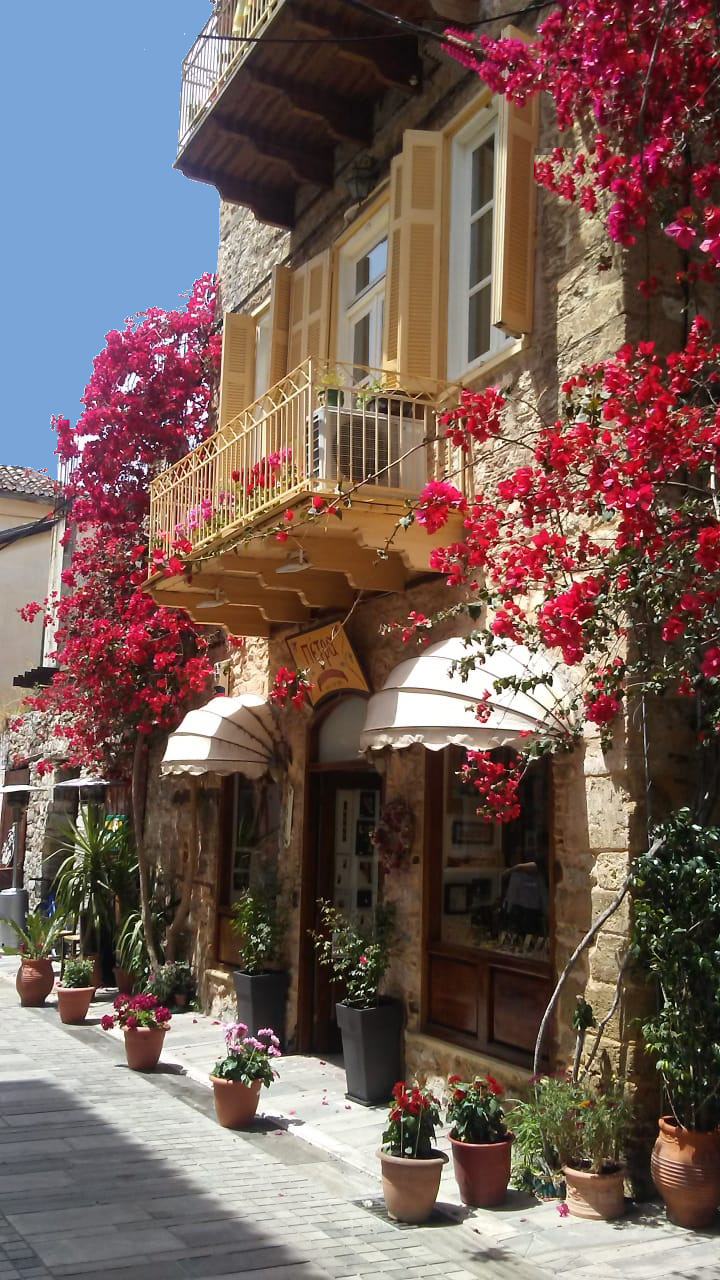
After free time for lunch in the enchanting town of Nafplion, we walk through Greek history from archaic times
to the present. Legend says that the town was founded by Nafplios, son of the god Poseidon. Nafplios' son Palamides fought in the Trojan War and today,
his namesake, the huge Palamides castle, still stands
atop the hill overlooking the
town. (Olympian walkers may choose to climb the 999 steps to the top). But there is more here than
history. Later, there is free time to
browse in the shops or to relax in the cafes.
Day 7 -
FREE DAY Today we have a
free
day. There are many possible activities:
-
Visit some of
the small, uninhabited islands .
-
Visit the archaeological site at nearby Asini. Here, remains of prehistoric settlements and parts of
ancient city walls can
be seen.
-
Climb a hill to find the Agia
Kyriaki, a picturesque church.
-
Explore the shops and
cafes of Tolo.
-
Enjoy an
optional half day food tour in nearby Napflion
-
Take a cooking class and learn the secret of making
traditional Greek dishes.
-
Relax at the
hotel's beautiful pool or swim in the sea
Day 8
MYCENAE - Today, we walk to legendary Mycenae. The 12 km
Olympian route is on King Agamemnon's path where, according
to legend, Agamemnon drove his golden carriage on his
triumphant return from the Trojan war. Continuing on, the
Olympians pass through olive and orange fields passing a
strange stone building which local legend claims was a guard
room to keep a watchful eye οn Hera, queen of all the gods,
when she passed by en route to her temple. The
Philosophers' walk is shorter (about 7 km). We start by
exploring the
archaeological site of Hera which was a temple dedicated
to Hera, goddess of fertility. Both walks end at Mycenae
(UNESCO). According to legend, its founder was the
hero Perseus, son of the god Zeus. In the second millennium
BC this was one of the major centres of Greek civilization,
a military stronghold which dominated the Hellenic world. At
its height in 1350 BC, the town had a population of 30,000
and scholars still are puzzled about why it declined. Our
guided
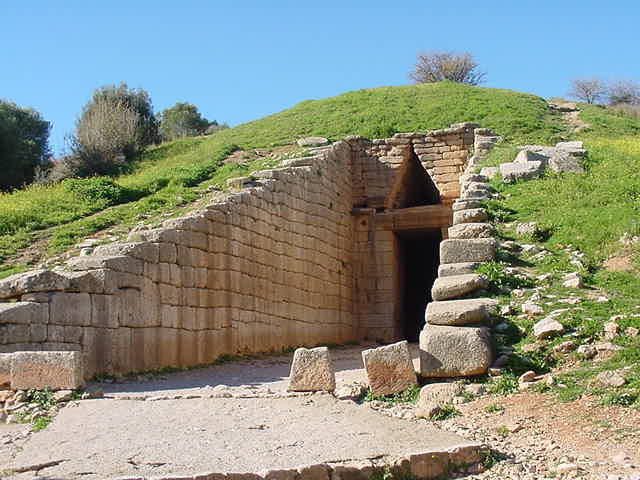
walking tour includes the Citadel and the famous Treasury of Atreus.
We marvel at the Cyclopean walls, perhaps built by giants or
elephants - no one knows for sure.
Day 9 - After an early morning check out of our Tolo hotel we transfer by coach to Athens Airport (about two hours) to
arrive about 09.30..
OPTIONAL EXTENSIONS
Full day tour from Athens to Delphi (operates daily)
Overnight tour from Athens to Delphi and Meteora. (operates
Mon, Wed, Sat )
|